

Houston window replacement at a glance
Many homeowners begin considering replacement because of fogged glass, difficult operation, excessive heat, water intrusion, deteriorated frames, or an outdated appearance. The right solution depends on whether the problem is limited to the glass or hardware, or extends into the frame and surrounding opening.
Start with the symptoms
Is It Time to Replace Your Windows?
Not every uncomfortable room or damaged window requires complete replacement. Hardware, weatherstripping, screens, individual panes, and minor exterior sealant problems can sometimes be repaired. Replacement becomes more reasonable when the problem affects the insulated glass, frame, operation, water resistance, appearance, or several windows throughout the home.
The first step is to identify what is actually happening. A window that feels drafty may have worn weatherstripping, but it could also have gaps between the frame and the wall. Water around a sill may be entering through the window, or it may be traveling from damaged siding, flashing, roofing, or another part of the exterior. Replacing the visible window without identifying the source can leave the underlying problem unresolved.


Fog or moisture between the panes
Moisture trapped between two panes usually means the seal around the insulated glass unit has failed. The window may continue to open and close, but the clouded appearance generally cannot be cleaned from either side.
In some cases, the insulated glass can be replaced while the existing frame remains. Complete replacement may be more practical when several seals have failed, the windows are approaching the end of their useful life, matching glass is unavailable, or the frames and hardware are also deteriorating.
Rooms that become unusually hot
A room that gets noticeably hotter than the rest of the house may be receiving substantial solar heat through its windows. This is often most noticeable through larger areas of glass exposed to direct morning or afternoon sun.
The solution is not simply to purchase any product described as “energy efficient.” Window orientation, glass coating, solar heat gain, frame construction, exterior shade, air leakage, and installation quality all affect how the room performs.
A new window may help reduce unwanted heat, but it should be selected using its tested ratings rather than a broad advertising claim.
Windows that are difficult to open or lock
A window may stick because of paint buildup, failed balances, damaged rollers, worn hardware, frame movement, corrosion, or distortion in the sash. A single broken component may be repairable. Replacement becomes more appropriate when several windows no longer operate safely, compatible parts are unavailable, or the frame itself is damaged.
Operation matters for more than convenience. Bedroom windows may need to provide an emergency escape opening, and a window that cannot stay open or lock securely may create a safety concern.
Water stains and deterioration around the opening
Peeling paint, dark staining, soft wood, swelling trim, or damaged drywall can indicate that moisture has reached the window opening. The visible symptoms do not always reveal where the water entered.
A proper evaluation should consider the frame, sill, exterior sealant, flashing, siding or masonry connection, and the wall above the opening. When damage extends behind the existing frame, full-frame replacement may provide better access for repairs than installing a smaller replacement unit inside the old frame.
When repair may still make sense
Repair is often worth considering when the frame remains structurally sound and the problem is limited to a lock, balance, roller, screen, weather seal, pane of glass, or small trim area. Older wood windows may also be candidates for restoration, particularly when they contribute to the architectural character of the house.
Replacement makes more sense when deterioration is widespread, insulated-glass failures are recurring, the existing frames are damaged, the windows no longer operate reliably, or the homeowner wants a meaningful change in style or performance.
Not sure whether you need window repair or replacement? Call and describe what you are seeing before deciding on a product.
Houston performance
Choosing Windows for Houston’s Heat, Sun, Rain, and Wind
A replacement window that performs well in one climate may not be the best choice for a Houston home. Houston experiences long periods of hot weather, strong solar exposure, humidity, and substantial rainfall. National Weather Service climate normals for Houston Intercontinental show typical July daytime highs in the low-to-mid 90s, making solar control and cooling-season performance important considerations.
Read the real product tag
Use the NFRC label to compare the exact window
The label ties the ratings to a specific window configuration. Start with the exact model and size on the quote, then compare the four measurements below instead of relying on a product-family brochure.
How the label is laid out
Four fields to compare
Match each rating to the exact quoted window
- U-factor0.27
Heat transfer through the complete window. Lower values indicate less heat transfer under the rating conditions.
- SHGC0.25
The share of solar heat admitted through the complete window. Lower values indicate less solar heat gain.
- Visible transmittance0.51
The share of visible light admitted through the complete window. Higher values indicate more daylight.
- Air leakage≤ 0.3
Air passing through the window under specified test conditions. Lower values indicate a tighter unit.
Sun and room comfort
Use the time of day to narrow the glass options
You do not need to know which direction your home faces. A window professional can confirm that during measuring. Start with when direct sun reaches the glass and how the room feels, then use the guide below to compare the right product details.
Morning heat or glare
Often associated with windows receiving direct east sun.
What to compare
Compare solar-control Low-E packages and SHGC values, then check that visible transmittance still provides the daylight you want.
Afternoon heat or glare
Often associated with windows receiving lower-angle west sun.
What to compare
Give solar control close attention. Compare SHGC, glass area, and any exterior shade, especially in rooms that stay hot into the evening.
Strong sun for much of the day
Common on south-facing glass when an overhang or tree does not provide enough shade.
What to compare
Balance SHGC with visible transmittance instead of automatically choosing the darkest glass. Window size and seasonal shade both matter.
Bright room with little direct sun
Common with north-facing or consistently shaded windows.
What to compare
Prioritize the complete window rating and useful daylight. A heavily tinted or aggressive solar-control package may not be necessary for that opening.
Ask the window professional
For these specific windows, which SHGC and Low-E glass package do you recommend, and how will it balance heat control with natural light?
Solar heat gain matters
Sunlight provides natural light, but it can also introduce unwanted heat. The effect is often strongest through large windows and through glass facing the morning or afternoon sun.
Solar heat gain coefficient, usually shortened to SHGC, measures how much solar heat passes through a complete window. A lower number means less solar heat enters. The Department of Energy recommends considering both climate and window orientation when selecting an efficient product rather than using the same glass specification automatically on every side of a home.
A lower SHGC can be especially useful for windows exposed to strong sunlight, but it should not be considered in isolation. Extremely dark glass may reduce daylight or alter the appearance of the home. The goal is to balance solar control, natural light, exterior appearance, and the specific orientation of each opening.
Read the complete window rating
Terms such as “double-pane,” “Low-E,” and “argon-filled” describe individual product features, but they do not provide a complete comparison. Two windows with those same descriptions can perform differently.
The National Fenestration Rating Council evaluates complete window products using ratings that include U-factor, solar heat gain coefficient, visible transmittance, air leakage, and condensation performance. U-factor describes heat transfer through the window, while visible transmittance indicates how much daylight passes through it.
The exact NFRC label for the proposed window configuration is more useful than a brochure describing an entire product family. Size, glass package, operating style, and grille configuration can affect the rating.
ENERGY STAR qualification is also based on climate-zone performance requirements. Homeowners should confirm that the exact window is labeled for the appropriate zone rather than assuming every product from an ENERGY STAR-participating manufacturer qualifies everywhere.
Humidity and condensation are not the same problem
Condensation can appear in several places, and each location suggests something different.
Moisture between the panes commonly points to a failed insulated-glass seal. Moisture on the room-facing surface can be related to indoor humidity, glass temperature, restricted airflow, or a combination of conditions. Water or staining around the frame may indicate air leakage, rain intrusion, or a problem elsewhere in the wall.
Replacement windows can improve surface temperature and air sealing, but no window should be advertised as a guaranteed cure for every humidity or condensation issue. Indoor moisture levels, ventilation, and air-conditioning operation still affect the result.
Rainwater must be managed around the entire opening
The window is only one part of the exterior wall. Even a well-rated product can leak when the opening is poorly prepared or the window is not integrated correctly with the surrounding wall.
The installation should account for the sill, flashing, drainage paths, exterior sealant, siding or masonry connection, and the condition of the existing weather-resistant barrier. The correct approach may differ between brick veneer, siding, stucco, and other wall systems.
A new bead of caulk around the visible edge should not be treated as a substitute for proper water management.
Impact windows are not automatically required everywhere in Houston
Houston is often discussed as though every property has the same coastal construction requirements, but the applicable rules depend on the exact location. The Texas Department of Insurance windstorm program covers designated catastrophe areas, including certain Harris County municipalities east of State Highway 146, rather than the entire Houston metropolitan area.
Impact-resistant windows may still be selected outside those designated areas for storm protection, security, sound control, or insurance-related reasons. However, laminated glass by itself does not necessarily make the complete window an approved impact assembly. The glass, frame, hardware, anchoring, product approval, and installation must function as a tested system.
Before purchasing a storm-related product, the homeowner or installer should verify the property address, applicable building requirements, insurance expectations, product documentation, and inspection process.
Build the right combination
Explore Window Styles, Frame Materials, and Glass Options
Replacement windows affect ventilation, natural light, exterior appearance, interior design, cleaning, and everyday operation. The right combination depends on the dimensions of the opening and what the homeowner wants that opening to do.


Choosing a window style
Single-hung and double-hung windows create a traditional vertical appearance that works with many Houston homes. A single-hung window opens from the bottom, while a double-hung window allows both sashes to move. Double-hung designs can provide additional ventilation and easier cleaning in certain models, although they may contain more moving parts and cost more than comparable single-hung windows.
Sliding windows move horizontally and work naturally in wide openings. They are commonly used in ranch-style homes, bedrooms, and spaces where a horizontal proportion fits the architecture. Homeowners should compare the track, rollers, drainage, locking system, and weatherstripping rather than viewing every slider as an identical product.
Casement windows are hinged at the side and generally open outward with a crank. When closed, the sash presses against the frame, which can provide a tight seal in a well-built unit. Casements also offer relatively unobstructed views, but the exterior swing must be considered near walkways, landscaping, and other obstructions.
Awning windows are hinged at the top and open from the bottom. They are often used in bathrooms, above fixed glass, or in contemporary window groupings. Picture windows do not open, but they can provide a broad view and allow more light into a room. They are frequently paired with operable windows when both ventilation and a large glass area are desired.
Bay and bow windows project beyond the exterior wall, creating architectural depth and additional interior space. They can become a focal point, but they require more structural, roofing, flashing, and finishing work than a standard flat window.
Frame material details


Comparing frame materials
The material name is a starting point, not a complete measure of quality. Two vinyl windows or two fiberglass windows can differ substantially in construction, reinforcement, hardware, finish, performance, and warranty.
Vinyl
- Common reasons homeowners consider it
- Lower maintenance, broad availability, and competitive pricing
- Important trade-offs
- Frame profiles and construction quality vary considerably
Fiberglass
- Common reasons homeowners consider it
- Strength, dimensional stability, and narrower profiles in some product lines
- Important trade-offs
- Generally costs more than entry-level vinyl
Composite
- Common reasons homeowners consider it
- Engineered construction and an alternative to conventional vinyl or wood
- Important trade-offs
- “Composite” can describe several different material systems
Wood or wood-clad
- Common reasons homeowners consider it
- Traditional appearance and compatibility with custom or historic architecture
- Important trade-offs
- Higher cost and more finish or maintenance considerations
Aluminum
- Common reasons homeowners consider it
- Narrow sightlines and a contemporary appearance
- Important trade-offs
- Thermal performance depends heavily on the frame design and thermal break
| Frame material | Common reasons homeowners consider it | Important trade-offs |
|---|---|---|
| Vinyl | Lower maintenance, broad availability, and competitive pricing | Frame profiles and construction quality vary considerably |
| Fiberglass | Strength, dimensional stability, and narrower profiles in some product lines | Generally costs more than entry-level vinyl |
| Composite | Engineered construction and an alternative to conventional vinyl or wood | “Composite” can describe several different material systems |
| Wood or wood-clad | Traditional appearance and compatibility with custom or historic architecture | Higher cost and more finish or maintenance considerations |
| Aluminum | Narrow sightlines and a contemporary appearance | Thermal performance depends heavily on the frame design and thermal break |
Vinyl is often selected for value-focused whole-home projects, but homeowners should compare more than price. Frame thickness, corner construction, internal chambers, reinforcement, finish options, and certified ratings all affect the finished product.
Fiberglass may appeal to homeowners who want a stronger frame or a slimmer profile. Wood and wood-clad products can preserve a traditional interior appearance and may fit historic or high-end renovations more naturally. Aluminum can support larger glass areas and contemporary design, but the complete NFRC rating should be reviewed because frame construction varies.
Understanding glass options
Double-pane insulated glass is common in modern replacement windows. Two panes are separated by a sealed space that may contain air or an insulating gas. This construction can improve thermal and sound performance compared with basic single-pane glass, but the phrase “double-pane” alone does not reveal the window’s SHGC, U-factor, or air-leakage rating.
Low-E coatings are designed to manage radiant heat and solar energy. Different coatings produce different results, so homeowners should ask how the selected package affects the complete window rating.
Laminated glass uses an interlayer that helps hold broken glass together. Depending on the full product design, it may support impact resistance, security, or sound control. Tempered glass is treated to break into smaller pieces and may be required in certain hazardous locations, including some openings near doors, floors, tubs, and showers.
Obscure or privacy glass can work well in bathrooms and street-facing rooms where daylight is wanted without a clear view. Privacy should be evaluated in both daylight and nighttime conditions because a glass pattern may behave differently when the interior is illuminated.
Triple-pane glass adds another pane and another sealed space. It can improve certain thermal or sound characteristics, but it also increases weight and price. In Houston, a well-selected double-pane product may offer a stronger cost-to-performance balance for many homes. The decision should be based on actual ratings and the homeowner’s goals rather than the assumption that more panes are always better.
Glass package in the complete window

- Glass panes
- The panes form the transparent faces of the insulated-glass assembly.
- Spacer system
- The spacer maintains separation between panes around the glass perimeter.
- Seals and coatings
- Edge seals and Low-E coating placement are specified as part of the complete glass package.
Design for the house
Choose Windows That Belong on Your Home
Replacement windows should look like part of the house rather than products inserted without regard for its architecture. Frame width, glass area, grille pattern, sash proportions, trim depth, color, and the relationship between neighboring windows all affect the finished appearance.
Window Design Inspiration
Match the window composition to the home


Brick ranch homes
Many Houston ranch homes have strong horizontal lines and relatively wide window openings. Sliding windows, picture windows, single-hung units, or carefully composed window groupings can maintain those proportions.
Bulky replacement frames may reduce the visible glass area, especially when an insert is placed inside an existing frame. Before approving the order, homeowners should compare the new frame dimensions with the current windows and understand how much glass will remain visible.
Frame color should be considered against the entire exterior. White may blend with existing trim, while bronze or black can create contrast against lighter brick. The roof, gutters, front door, fascia, and garage door should also be considered so that the windows do not look disconnected from the rest of the home.
Traditional two-story homes
Traditional elevations often depend on repetition and symmetry. Window head heights, grille patterns, frame colors, and sash proportions should remain consistent across the front of the house.
Single-hung or double-hung windows commonly preserve the vertical appearance of these homes. Picture windows can be incorporated into larger groupings, but grille lines should align with neighboring units so the overall composition remains balanced.
Craftsman homes and bungalows
Craftsman homes and bungalows often have deeper trim, divided-light patterns, grouped windows, wood details, and carefully proportioned sashes. Replacing those elements with a generic flat window can remove much of the character that made the home distinctive.
Repair should be considered when original windows remain serviceable, particularly on highly visible elevations. When replacement is appropriate, the new profile, grille configuration, trim, and material should respect the original design rather than merely fit within the opening.
Contemporary homes
Contemporary homes often use larger areas of glass, fewer grilles, narrower sightlines, and strong alignment between openings. Casement, awning, picture, and large sliding windows can support that design language.
Black windows are popular in contemporary renovations, but they are not automatically the correct premium choice. A dark, bulky frame can appear heavier than expected, and interior black frames may dominate a room with light finishes. Physical samples and realistic exterior elevations are more useful than viewing a small color square in a brochure.
Stucco and Mediterranean-inspired homes
Stucco elevations may include arched openings, deep returns, cast-stone trim, and warm exterior colors. Window replacement must account for how the frame connects to the stucco and underlying drainage system.
The visual decision is also important. Bronze, tan, dark brown, or warm neutral frames may coordinate more naturally than bright white on some homes. Arched or geometric units should match the opening accurately rather than relying on oversized trim to conceal a poor fit.
Historic Houston properties
Exterior changes to a City-designated landmark or a property in a designated historic district may require a Certificate of Appropriateness. The City of Houston states that a COA is required for projects that alter the exterior appearance of designated historic properties, while ordinary maintenance and certain repairs may be exempt.
Homeowners should determine whether the property is designated before ordering nonreturnable windows. The existing units may need to be evaluated for repair, and a replacement may need to match the original dimensions, configuration, material, grille pattern, and trim.
An installer’s recommendation does not replace approval from the City, a historic commission, or a neighborhood association.
Plan the installed scope
How Much Does Window Replacement Cost in Houston?
Window replacement pricing varies too much for one universal “average” to describe every project accurately. Window size, style, frame material, glass package, installation method, access, trim work, and concealed damage can all change the cost.
Window Replacers publishes a numeric planning range only when it resolves through the active, reviewed version of its proprietary pricing model. The range below identifies its geographic basis and does not substitute an unsupported Houston average.
Use the estimator below to organize the window count, sizes, access, frame preference, and priorities before requesting a measured written quote.
Window size and configuration
- How it affects the project
- Oversized glass, grouped units, arches, and custom shapes generally cost more than standard rectangular openings
Operating style
- How it affects the project
- Casement, double-hung, bay, bow, and specialty units use different hardware and installation methods
Frame material
- How it affects the project
- Entry-level vinyl generally costs less than premium fiberglass, composite, wood-clad, or specialty aluminum
Glass package
- How it affects the project
- Laminated, impact-rated, tempered, privacy, decorative, and sound-control glass can increase product costs
Installation method
- How it affects the project
- Full-frame replacement usually requires more demolition, flashing, trim, and finishing than an insert
Height and access
- How it affects the project
- Second-story openings, narrow side yards, landscaping, and oversized units may require additional labor or equipment
Existing damage
- How it affects the project
- Rot, water intrusion, deteriorated trim, framing issues, and damaged sheathing may add work that was not visible initially
| Cost factor | How it affects the project |
|---|---|
| Window size and configuration | Oversized glass, grouped units, arches, and custom shapes generally cost more than standard rectangular openings |
| Operating style | Casement, double-hung, bay, bow, and specialty units use different hardware and installation methods |
| Frame material | Entry-level vinyl generally costs less than premium fiberglass, composite, wood-clad, or specialty aluminum |
| Glass package | Laminated, impact-rated, tempered, privacy, decorative, and sound-control glass can increase product costs |
| Installation method | Full-frame replacement usually requires more demolition, flashing, trim, and finishing than an insert |
| Height and access | Second-story openings, narrow side yards, landscaping, and oversized units may require additional labor or equipment |
| Existing damage | Rot, water intrusion, deteriorated trim, framing issues, and damaged sheathing may add work that was not visible initially |
The same $750–$1,725 engine result is used by this page's range card, planner, and cost FAQ. The factors above can change a measured provider quote.
Houston window cost estimator
Estimate your window replacement cost
Enter the number of windows you may replace to see the Houston planning range from the active Window Replacers pricing model. Add the project details you will want included in a final quote.
Insert replacement usually costs less—but is not always the right choice
An insert window is installed within the existing frame. This approach can reduce disruption to the interior and exterior trim, but it only makes sense when the retained frame is in suitable condition.
A full-frame installation removes the old frame and exposes more of the opening. It usually costs more, but it can provide access to damaged materials, old flashing, poor installation details, or an opening that needs to be rebuilt.
A lower insert price is not a good value when the existing frame is already deteriorated or allowing water into the wall.
Whole-home replacement versus replacing a few windows
Replacing the entire house at once can produce consistent frame colors, glass appearance, grille patterns, warranties, and installation details. It may also reduce repeated setup and mobilization costs.
A phased project can still be sensible. Homeowners may begin with failing windows, the sunniest side of the home, bedrooms with operation concerns, or the front elevation where appearance matters most.
The risk of phasing is future availability. Manufacturers can change colors, product lines, hardware, and grille patterns. A homeowner planning several phases should ask how likely the selected configuration is to remain available.
What should be included in the price?
A useful estimate should make clear whether the price includes removal, disposal, interior and exterior trim, flashing, insulation, sealant, screens, hardware, taxes, permits when required, cleanup, and warranty service.
It should also explain what happens when concealed water or wood damage is discovered. An inexpensive quote can become far more expensive when the original scope excludes work that another company included from the beginning.
Be careful with guaranteed savings claims
Replacement windows can improve comfort, operation, appearance, air sealing, and solar control. Actual utility savings depend on the existing windows, insulation, ductwork, HVAC equipment, thermostat settings, shade, house orientation, energy prices, and homeowner behavior.
A window company should not promise a specific reduction in the electric bill without a defensible property-specific analysis.
Installation scope comparison
See what changes at the opening
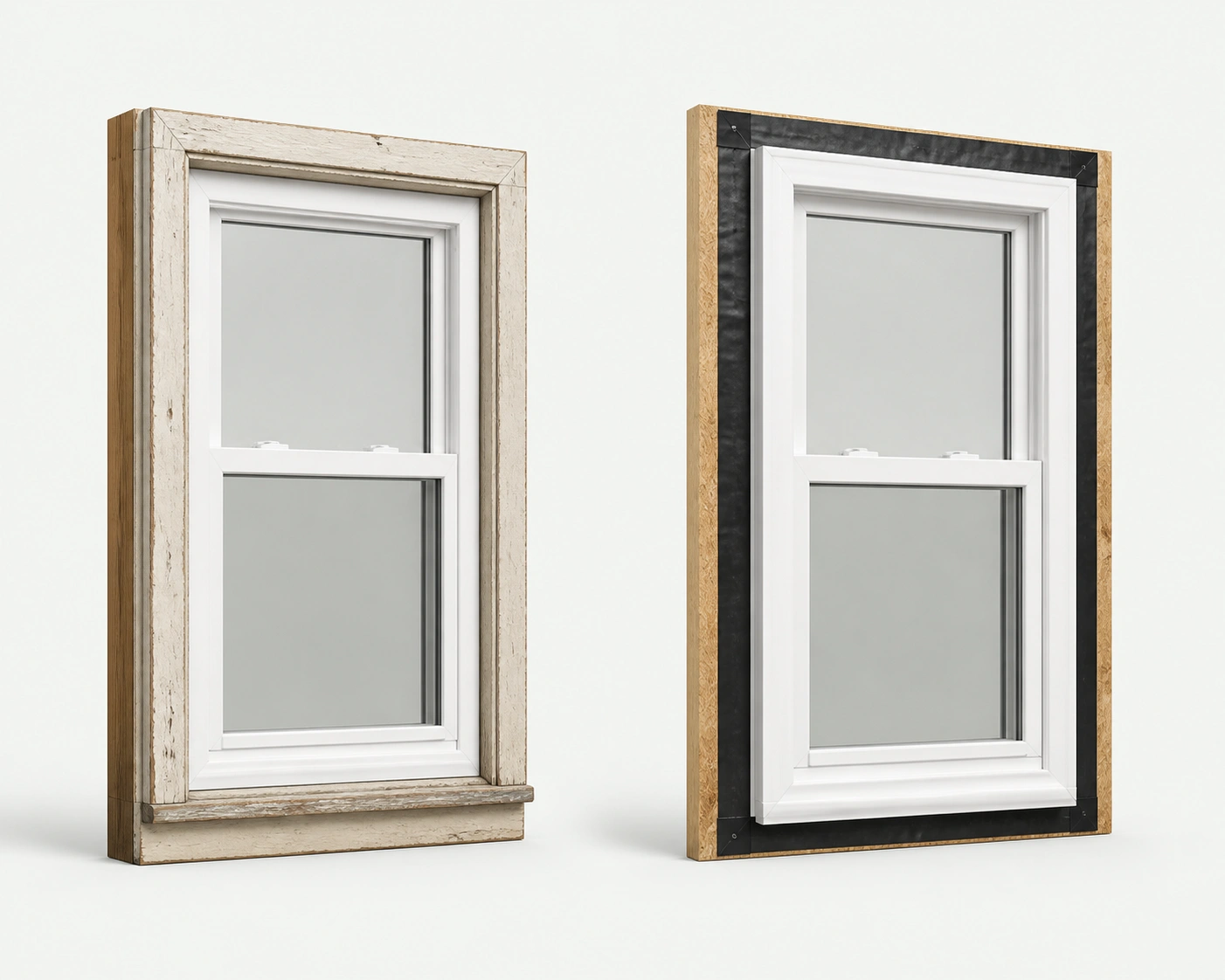
Insert replacement
The existing frame remains after its condition, drainage, dimensions, and suitability are confirmed.
- Existing frame retained
- New unit fitted inside
- Finish scope defined separately
Full-frame replacement
The old unit and frame are removed so the opening can be inspected before the new frame is flashed, set, sealed, and finished.
- Opening exposed for review
- New full frame installed
- Flashing and finish scope included
Call to discuss the approximate number of windows, home style, number of stories, and primary reason for replacement.
From evaluation to walkthrough
What Happens During Window Replacement?
A professional window project begins before the old window is removed. The existing openings must be evaluated, the correct products measured and ordered, and the installation method defined in writing.

Drag the divider, click or tap the image, or use the arrow keys.
The initial evaluation
The first conversation should focus on what the homeowner wants to change. Some projects are driven by fogged glass or difficult operation. Others are primarily about solar heat, outside noise, storm protection, maintenance, or appearance.
During an on-site visit, the professional should evaluate the visible condition of the frame and surrounding materials. The wall type, trim, sill, opening size, height, accessibility, possible water damage, and existing installation all influence the recommended approach.
Measurements should account for the complete window, not simply the visible glass.
Selecting and ordering the windows
Before the order is finalized, the homeowner should receive a written product specification. That specification should identify the manufacturer, series, operating style, size, frame material, colors, glass package, grilles, screens, hardware, performance ratings, and installation method.
Custom windows are often manufactured for the specific opening and may not be returnable. Frame colors, glass types, grille patterns, tempered-glass locations, and opening directions should be reviewed carefully before production begins.
The ordering period is separate from the installation period. Standard products may arrive relatively quickly, while specialty colors, custom shapes, oversized glass, and impact systems may take longer.
Preparing the home
Furniture, curtains, blinds, alarm sensors, and fragile items may need to be moved away from the openings. The installer should explain what the crew will protect and what the homeowner needs to remove.
Pets should be secured, and access should be cleared both inside and outside. Landscaping, patios, and interior flooring may require protection depending on the location of the windows.
Removing the old window and examining the opening
Installers generally work on one or a limited number of openings at a time so the home is not left widely exposed.
Once the old window or sash is removed, previously hidden conditions may become visible. Water staining, soft wood, corrosion, damaged sheathing, missing flashing, or framing problems should be documented before the new window is installed.
The contract should explain how unexpected repairs are priced and approved. The homeowner should not learn about a large additional charge only after the work has been completed.
Installing and finishing the new window
The new unit must be positioned correctly, secured according to the product requirements, insulated around the frame, and integrated with the opening so water can drain toward the exterior.
Depending on the project, the work may include sill preparation, flashing, shims, approved fasteners, low-expansion foam, backer rod, sealant, exterior trim, interior casing, and finish repairs.
The appropriate details depend on the window, wall construction, and installation method. There is no single bead of caulk that can compensate for every underlying condition.
The final walkthrough
Each operable window should be opened, closed, and locked. Screens, glass, frame surfaces, trim, and sealant should be inspected. The crew should remove debris and explain basic operation, cleaning, and warranty procedures.
The homeowner should receive product information and know whom to contact for installation service. Manufacturer coverage and labor coverage may come from different parties.
Insert versus full-frame installation
An insert replacement retains the existing frame and places a new unit within it. It can reduce disruption and work well when the retained frame is dry, sound, and properly integrated with the wall. Because the new window sits inside the old frame, the visible glass area may become smaller.
Full-frame replacement removes the existing frame and exposes more of the rough opening. This approach may be appropriate when the frame is deteriorated, water damage needs to be addressed, the original installation was poor, or the homeowner wants to change the window configuration.
Full-frame work is usually more involved, but it provides greater access to the opening and can avoid building a new window inside a failed frame.
Make proposals comparable
How to Compare Houston Window Replacement Quotes
Two proposals can list the same number of windows and still describe very different projects. One may use a basic product installed inside the existing frames, while another includes a different glass package, full-frame removal, new flashing, trim repairs, and a longer labor warranty.
The total price makes sense only when the written scopes are compared.
Quote checklist
Make sure every quote answers the same questions
If a detail is not written down, ask the installer to add it before comparing totals. A shorter quote is not necessarily a simpler project.
Exact product
Manufacturer, product line, operating style, frame material, finish, and glass package.
Window ratings
U-factor, SHGC, visible transmittance, and air-leakage values for the exact quoted configuration.
Installation method
Whether the work is insert or full-frame, plus what will be removed, inspected, flashed, insulated, and sealed.
Finish and trim
What happens to interior casing, exterior trim, paint, sealant, screens, and touch-up work.
Unexpected repairs
How concealed damage will be documented, priced, and approved before additional work begins.
Project responsibilities
Who handles permits, HOA requirements, debris removal, daily cleanup, and the final walkthrough.
Coverage and payment
Product and labor warranties, exclusions, responsible parties, deposit, milestones, and final-payment terms.
Look beyond the word “lifetime”
A lifetime warranty can sound comprehensive while containing important exclusions. Coverage may differ for the frame, glass seal, hardware, screen, exterior finish, accidental breakage, and labor.
The homeowner should determine whether the warranty is prorated, whether it transfers to a future owner, whether service-call charges apply, and who is responsible for removing and reinstalling a defective product.
The written warranty matters more than the headline used in the sales presentation.
Ask who will perform the installation
Some companies use employees, some use subcontractors, and others use a combination. The employment arrangement alone does not determine quality, but responsibility should be clear.
The homeowner should know who manages the crew, who carries the applicable insurance, who handles service requests, and whether the company selling the project remains responsible for the completed installation.
Be cautious with same-day pricing pressure
Window projects involve custom products, significant costs, and decisions that can affect the home for years. A legitimate promotion may have an expiration date, but the homeowner should not be pressured into signing before the product, installation scope, financing terms, and warranty have been reviewed.
Large discounts based on an inflated starting price can make comparison difficult. The final written price and scope are more useful than the advertised percentage discount.
Compare value, not just the lowest number
A higher quote is not automatically better, and a lower quote is not automatically a problem. The objective is to understand why the prices differ.
One company may be proposing a stronger product. Another may include repairs or trim work. A third may simply charge more for a similar scope. Detailed specifications allow the homeowner to identify those differences rather than guessing.
Answers for Houston homeowners
Houston Window Replacement FAQs
How much does it cost to replace windows in Houston?
What type of window is best for Houston?
What window rating is most important in Houston?
Are impact-resistant windows required in Houston?
Can a fogged window be repaired without replacing the frame?
Should every window be replaced at the same time?
Will replacement windows reduce outside noise?
Is triple-pane glass necessary in Houston?
How long does window replacement take?
Can windows be replaced during a Houston summer?
Can replacement windows be installed when rain is expected?
Do I need HOA approval?
Do historic Houston homes have special requirements?
Are black replacement windows more expensive?
Will replacement windows lower my electric bill?
Next steps
Find the Right Replacement Windows for Your Houston Home
Window replacement brings together design, comfort, performance, installation, and cost. The right choice is not necessarily the product with the most features. It is the product and installation method that address the actual condition of the home without creating unnecessary expense.
Window Replacers helps homeowners understand the available options and check professional availability in their area. You do not need to know the exact window measurements or technical terminology before calling. Begin with the approximate number of windows, the age and style of the home, the problems you have noticed, and what you would most like to improve.
When available, we may help connect you with an independent window professional serving Houston or a surrounding community, including Katy, Cypress, Sugar Land, Pearland, Missouri City, Spring, Tomball, Humble, Kingwood, Pasadena, Baytown, League City, Friendswood, and The Woodlands. Availability depends on the ZIP code and project type.

Ready when you are
Talk Through Your Window Replacement Project
Describe what is happening with your current windows, ask questions about the available materials and glass packages, and learn what information you should expect in an estimate.
Speak with someone about your window problems, project priorities, and next steps.
Tell us where the home is located, approximately how many windows are involved, and what you want the project to accomplish.
Window replacement around Houston
Availability depends on the ZIP code and project type.
Window Replacers is a homeowner information and connection service. Independent professionals determine service availability, products, estimates, installation methods, warranties, financing, and contract terms.
Official sources used for Houston window guidance
- Window Energy Performance RatingsNational Fenestration Rating Council
- Residential Windows, Doors, and SkylightsENERGY STAR
- Window Types and TechnologiesU.S. Department of Energy
- Designated Catastrophe Areas and Windborne-Debris RequirementsTexas Department of Insurance
- Houston Intercontinental Climate NormalsNational Weather Service Houston/Galveston
- Houston Certificate of Appropriateness GuidanceCity of Houston Office of Preservation